-
Continuing professional development at FDSP
-
Continuing education and distance learning
-
Pricing and Financing
-
Continuing education registrations
-
Continuing education courses
If you'd like to resume your studies, acquire new skills or update your existing ones, the Continuing Professional Training Department will welcome you, advise you on the process and provide administrative support for your training at the Faculty of Law and Political Science.
-
Target audience
The status of continuing vocational training - distinct from that of initial training students - applies to people returning to school after entering the workforce , or those wishing to acquire/update knowledge and skills designed to promote professional development.
Continuing professional development is therefore particularly aimed at adults. Within the University, they are referred to as "trainees in continuing education" (and not "students").
They include
- employees not on student contracts
- employees on professionalization contracts (but not apprenticeship contracts),
- permanent and contract civil servants,
- liberal professions, self-employed workers, craftsmen and shopkeepers,
- people registered with France Travail (formerly Pole emploi) or Cap emploi,
- RSA beneficiaries,
- people whose training is financed by a third-party organization (CPF, employer, OPCO, France Travail, public authorities, etc.),
- people wishing to return to work after having interrupted their professional activity to take care of their children, spouse or ascendants,
- people following a training course with specific continuing education facilities,
- VAP (Validation des Acquis Professionnels) or VAE (Validation des Acquis de l'Expérience) graduates.
Please note: continuing education status is incompatible with CROUS scholarship status, which is reserved for initial training students.
Receiving compensation from France Travail (formerly Pole Emploi) or the RSA is incompatible with student status, but is possible under continuing education status (see your advisor before enrolling).
-
Continuing education courses
Virtually all the courses offered by the Faculty of Law and Political Science are open to students with continuing education status (from law degrees to Masters, as well as institutional diplomas), provided they meet the admission requirements and comply with the application procedures.
-
Facilities for continuing education
Almost all the courses offered by the Faculty of Law are open to continuing education students, and some are specifically designed for them.
Specific training courses for continuing education
Among these courses, the EAD distance learning courses (Licence Droit, Master Droit des affaires appliqué and Master Droit public et carrières publiques ) are particularly well suited to students who need to reconcile their studies with a professional activity and/or family commitments.
Special arrangements have been put in place for continuing education students in EAD: in Licence and Master 1, dedicated tutorial groups are held by videoconference in the evenings, and regular videoconference meetings are held with subject referents.
Certain Master's degrees and institutional diplomas (DESU/CESU/DU/CU) are open exclusively to continuing education students.
Training facilities
Most of our courses are offered to a mixed audience, with both initial training students and continuing education trainees taking part in the classes.
However, to facilitate access for continuing education students, and with a view to providing better individual support, a number of adjustments are possible:
- apply for a Special Study Plan (Régime Spécial d'Etudes - RSE) if you are a salaried employee or have family responsibilities (priority in choice of tutorial groups, attendance waivers, etc.),
- apply to the diploma coordinator to follow the course over 2 years instead of one, in order to reduce the annual volume of courses to be taken,
- define other adaptations with the teachers in charge of the courses, to enable a more individualized approach (e.g. writing an activity report instead of an internship report),
- if previous professional experience allows, initiate a partial VAP (validation of professional experience) procedure, allowing exemption from certain subjects.
-
Admission requirements / Applications
Automatic access
CAPACITÉ EN DROIT: open to students who do not hold a Bac-level diploma (registration without diploma requirements - evening classes at the Marseille Canebière site),
LICENCE mention Droit 1ERE ANNEE: open to holders of the French (or European) baccalauréat or a French level IV diploma, or to students repeating a Licence 1 mention Droit from a French university.
LICENCE mention Droit 2EME ANNEE: open to holders of a Licence 1 mention Droit from a French university or repeaters of a Licence 2 mention Droit from a French university,
LICENCE mention Droit 3EME ANNEE : accessible to holders of a Licence 2 mention Droit from a French University or repeating a Licence 3 mention Droit from a French University.
- IMPORTANT :
- students with continuing professional education status MUST NOT register on ParcourSup to access Licence 1 Droit, as this access procedure is intended for initial training students (neo-bacheliers).
- non-EU students should refer to the "application procedures" web page.
- special licenses, i.e. the Licence option Santé (LAS), the double Licences, the Licence Kent... are not accessible to continuing professional education students.
ATTENTION: In accordance with the examination regulations, the number of consecutive administrative registrations for a Licence is limited to five, including three for the first two years (Licence 1 and Licence 2) and two for Licence 3. If you wish to enroll more than the authorized quota, you must send the Continuing Education Department a waiver request form, together with a covering letter.
In Master 1 and Master 2 courses, repeating a year is only allowed on the basis of a jury's decision.
Access on application
- Requests for equivalence for direct access to LICENCE 2 Droit or LICENCE 3 Droit : applications from March 3, 2025 to April 1, 2025 via the "E-candidat" platform.
- LICENCES PROFESSIONNELLES : application via the "E-candidat" platform or on paper (procedures and dates vary according to degree).
- MASTERS 1: application via the ministerial "Mon Master" platform from February 25, 2025 to March 24, 2025
- MASTERS 2: application via the "E-candidat" platform (between April 25 and May 28, 2025)
- Diplômes d'établissement (DESU/DU/ CESU/ CU): please contact us.
IMPORTANT: Foreign students must follow the application procedure applicable to their situation (nationality, place of residence, diplomas held).
Update to come for 2026/2027
Access based on validation of prior learning
VAP: Validation of professional experience (V.A.P.) enables students to enter a university course without having the required diploma (for example, a holder of a bac+3 to enter the second year of a master's degree at bac+5 level), by having professional experience or personal achievements validated. It can also be used as a means of modifying a student's course of study, with exemptions from certain courses.
VAE: Validation of acquired experience (V.A.E.) enables certification of all or part of a diploma. This certification involves writing and defending a dossier before a VAE jury.
These two procedures are managed in collaboration with Aix Marseille University's Service For'Pro.
For further information: fdsp-scol-fc@univ-amu.fr
Distance learning courses offer a more flexible alternative to face-to-face learning.
Whether you're returning to school, retraining or upgrading your skills, the ability to work remotely and at your own pace is a major advantage for continuing education profiles.
** IMPORTANT: OUR DISTANCE LEARNING COURSES ARE NOT ACCESSIBLE TO FOREIGN STUDENTS FROM OUTSIDE THE EUROPEAN COMMUNITY.
-
Distance learning courses
LIcence Law 1st year distance learning Law degree 2nd year distance learning Law degree 3rd year distance learningThe 3 years of the Bachelor's degree in law are offered by distance learning:
Master 1 in Law - Applied Business Law (distance learning) Master 1 in Law - Public Law and Public Careers (distance learning)We offer two distance learning Master 1 courses, accessible by application via the national Mon Master platform:
- M1 in Law - Applied Business Law: https: //monmaster.gouv.fr/formation/0134009M/2400031JKJ2Z/detail
- M1 in Law - Public Law and Public Careers: https: //monmaster.gouv.fr/formation/0134009M/2400031JKCIJ/detail
Master 2 in Law - Applied Business Law (distance learning) Master 2 in Law - Public Law and Public Careers (distance learning)We offer two distance learning Master 2 courses, accessible by application via the E-candidat platform:
- M2 Law - Public Law and Public Careers course
- M2 Law - Applied Business Law course
-
Organization of distance learning
Academic calendar Licence EAD 2025-2026 Academic calendar Masters 1 EAD 2025-2026Courses are delivered entirely by distance learning via AMeTICE, AMU's digital Moodle platform. They are made available in text format, can be consulted at any time and downloaded. They are largely taught by teacher-researchers from our Facultý, and for a complementary part by courses from the Université́ Numérique Juridique Francophone (UNJF).
Tutorial assignments (TD) in Licence and Master 1 are worked on by the learner from documents deposited on AMeTICE and must be handed in via the platform according to a schedule communicated at the start of the academic year. A grade is awarded for each assignment handed in, a general correction is communicated and the TD supervisors send each student a personalized correction and methodological recommendations to help them progress and provide pedagogical support.
Visio Zoom meetings are organized from time to time by the course instructors to enable direct interaction and facilitate communication on any pedagogical difficulties encountered.
Exchange forums enable learners to communicate with their teachers, the latter providing answers to questions that are visible to all.
Only the exams are held face-to-face in Aix-en-Provence, for one week at the end of each semester.
There are no compulsory internships for EAD courses (Master's students must choose between writing an internship report or a research dissertation), and it is possible to draw up an internship agreement if the student wishes to carry out an optional (voluntary) internship, which will not be graded but will enhance the student's academic record: link to the CE internships page.
SPECIAL ARRANGEMENTS FOR CONTINUING EDUCATION :
- in the Licence and Master 1 programmes, tutorial groups are reserved for continuing education: each session is associated with a video-zoom moderated by the tutor, positioned at the end of the afternoon (after 6 p.m.) to enable as many people as possible to join in and discuss methodology and homework assignments
- the possibility of requesting a two-year course instead of one, in order to lighten the annual workload (granted by decision of the educational advisor)
- in the Master's program, the possibility of writing an activity report, in agreement with the employer, instead of an internship report or research dissertation.
Download below the academic calendars for 2025-2026 (Licence EAD and Master 1 EAD):
-
Pricing Continuing education
-
Financing arrangements
* How to create a digital identity and mobilize the CPFPlease note If you are covered by the continuing education system, it is your responsibility to find a financing method that suits your status and allows your training costs to be covered by a third party.
Mobilizing your Personal Training Account (CPF):
You can find out how to mobilize your Compte Personnel de Formation (CPF): https: //travail-emploi.gouv.fr/formation-professionnelle/droit-a-la-formation-et-orientation-professionnelle/compte-personnel-formation
The hours in your Personal Training Account (CPF) are acquired in proportion to the time you work, and you keep them throughout your working life, even if you are unemployed.
We would like to inform you that access to the Mon Compte Formation platform for purchasing training has been made more secure. A FranceConnect+ ID will now be required to connect, and the creation of a La Poste Digital Identity is essential.
**Please note**: since May 2, 2024, people who register for a training course are required to make a financial contribution . However, there are exceptions, so please consult https://www.moncompteformation.gouv.fr/espace-public/une-participation-financiere-obligatoire-pour-mobiliser-vos-droits-cpf
IMPORTANT, concerning the Mon Compte Formation platform:
- not all our training courses are eligible for CPF mobilization. Certification by the RNCP (or the Répertoire Spécifique) and mention of Aix-Marseille Université as a certifying body on the course's RNCP sheet are essential prerequisites. In addition, when a course comprises several years of training, only the year of certification (year of graduation) can be referenced (e.g. L3 for a Bachelor's degree and M2 for a Master's degree). To find out which courses are eligible and how to apply, please contact us before the start of your course, preferably by the end of June 2025.
- the CGU of the Mon compte Formation platform - to be read carefully - impose incompressible deadlines between the request to mobilize the CPF and the start of the training, so don't apply too late to use this means of financing. Note that processing times may also be lengthened by the creation of a La Poste Digital Identity, required to connect to the Mon compte Formation platform;
- if your CPF and any matching contribution from France Travail or your employer do not fully cover the cost of your continuing training, you will have to pay the difference by credit card directly on the platform, in a single payment (no possibility of instalments).
NB: civil servants should contact their HR department to find out how to mobilize their CPF and what funding may be available. They should not use the Mon Compte Formation platform (CPF balance in hours, not euros).
Other financing options:
-
If you are an employee:
To finance your training, please first contact your employer's Human Resources Department to find out if there are any possibilities for funding (particularly as part of the training plan).
If your employer is unable to cover this cost himself, he should contact the OPCO (Opérateur de Compétences) on which he depends (depending on your professional branch) and which may be able to finance you.
If you wish to mobilize your CPF, your employer can contribute to the financing of your training through a matching contribution paid directly into the Mon Compte Formation platform.
-
If you are a non-salaried worker (liberal professions, farmers, craftsmen, shopkeepers, self-employed workers, etc.):
Contact your training insurance fund (F.I.F.-P.L., OPCO EP,.. .): https://entreprendre.service-public.fr/vosdroits/F31148
Application for partial CF exemption-
If you are a job-seeker (with or without benefits):
You must inform your France Travail (ex Pole Emploi) advisor of your training project, and he/she must give you a prescription document validating this project: this is the personalized employment access project (PPAE).
Your advisor will also tell you how you can maintain your compensation during your training.France Travail (formerly Pole Emploi) may be able to finance your training under the AIF (Aide Individuelle à la Formation) scheme: you should contact your France Travail advisor before the start of your training.
If you wish to mobilize your CPF via the "Mon compte formation" platform, France Travail may be able to contribute to your financing through a matching contribution paid directly to the platform.
Another way for jobseekers to find funding is to contact complementary pension funds via their "Action Sociale" services. To find out which pension fund to contact according to your situation, visit https://espace-personnel.agirc-arrco.fr/public/dopli
-
If you are receiving RSA benefits:
You must inform your RSA advisor of your training project, and he or she must give you a prescription document validating the project, to avoid any interruption in your benefits.
The Conseil Départemental provides funding under the Programme Départemental d'Insertion (Departmental Integration Program) for RSA beneficiaries: your advisor will inform you of the conditions of attribution,
-
If you are disabled:
You can apply to AGEFIPH (Fonds pour l'insertion professionnelle des personnes handicapées).
-
If you have to finance your training yourself:
Please note: when you register, you will be asked to provide proof that the third-party financer has refused to cover your costs, depending on your status (employer, OPCO, France Travail, etc.).
If you have been refused funding by a third party, or if you are unable to use your CPF, you can :
-
request a 3-installment payment schedule for your training fees (please bring a bank account number and a cheque).
PLEASE NOTE: for fees over €1,000.00, a 3-installment payment plan will be granted; for amounts under €1,000.00, your request will be examined by the accounting agency (please include a letter stating the reasons for your request, together with supporting documents).
- and/or submit a request for partial exemption from training fees based on social criteria, which will be examined by the Exemption Commission (except for DESU/DU/CESU/CU):
-
*** IMPORTANT: This page only concerns CONTINUING PROFESSIONAL TRAINEES (working people, jobseekers, RSA recipients, etc.) and not students ***
CONTINUING PROFESSIONAL EDUCATION
REGISTRATION CAMPAIGN FOR ACADEMIC YEAR 2025/2026 :
from july 7, 2025 (2:00 pm) to july 25, 2025 (12:00 pm)
then from august 25, 2025 (2:00 pm) to september 19, 2025 (4:00 pm)
(Registration will be interrupted during the summer closure of the Registrar's Office)
ATTENTION :
for CURSUS A DISTANCE EAD (Bachelor's and Master's degrees), reduced registration campaign: see dates on the dedicated page
for institutional diplomas (DESU/CESU/DU/CU) : registration from September 15, 2025.
Update to come for academic year 2026/2027
-
Administrative registration
Request for a waiver for additional registration in the Bachelor's programAdministrative registration is an annual process, and must be renewed for each new academic year.
IMPORTANT In accordance with the examination regulations, the number of consecutive administrative registrations for the Licence program is limited to five, including three for the first two years (Licence 1 and Licence 2) and two for Licence 3. If you wish to register more than the authorized quota, you must send the Continuing Education Department a request for exemption form, together with a letter of motivation
If you have the required qualification, or if your application to has been approved, you can follow the procedure below.
STEP 1: Application form
Print out the registration form and the information sheet, complete them with the help of the appendices, and attach the supporting documents requested.
Please note: No registration will be processed if the file is incomplete.Download registration documentsBEFORE REGISTERING :
If you are registered with France Travail (formerly Pôle emploi) : contact your France Travail advisor as soon as possible to validate your enrolment (prescription) and find out about funding options. AISF (attestation d'inscription à un stage de formation - certificate of registration for a training course - to be completed by the University) will be issued, and the PPAE (Projet Personnalisé d'Accès à l'Emploi - Personalized Employment Access Project) will be drawn up, indicating whether or not funding has been approved.
If you are receiving RSA (Revenu de Solidarité Active) benefits: contact your RSA advisor to have your training project validated (prescription) and avoid suspension of your benefit rights.Please note If you are in one of these two cases, so as not to lose your rights, tell your advisor that you will have the status of "Continuing Education Trainee" and not "student".
STEP 2: Submission of registration form and payment of continuing education fees
Once your application is complete, you must register for the Continuing Education program as follows:
- either IN PERSON, without appointment, during opening hours (9:00 am to 12:00 pm and 1:30 pm to 4:00 pm / service closed on Tuesday afternoons);
- or BY MAIL, in FOLLOW-UP mode (IMPORTANT: NO REGISTERED MAIL).
Our address is :
Faculty of Law and Political Science AMU
Service Formation Continue
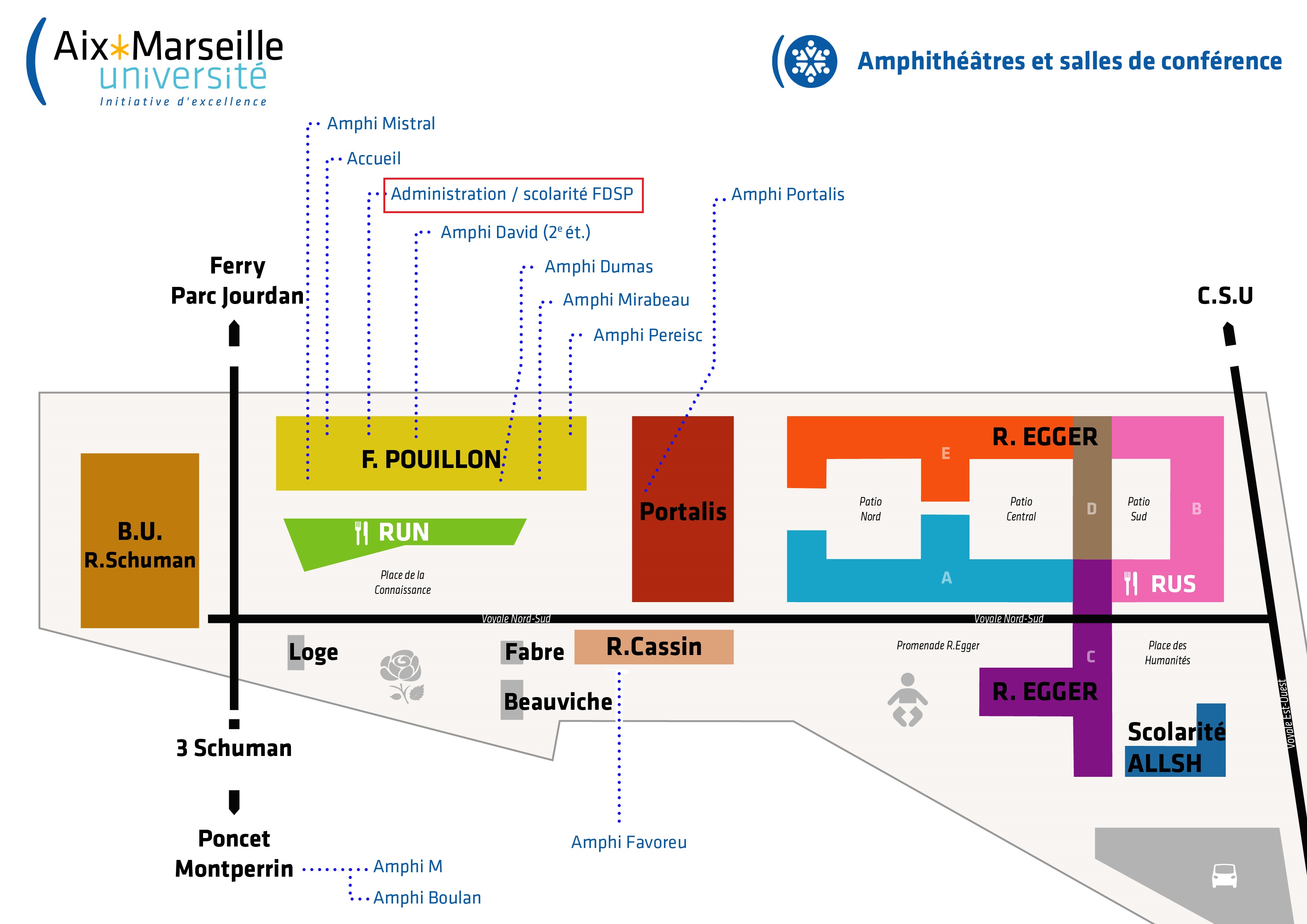
Ground floor, Pouillon building - office 12
3 avenue Robert Schuman - 13628 AIX EN PROVENCE CEDEX 1PLEASE NOTE: Applications sent by e-mail will be systematically rejected.
Continuing education students attending courses at the ARLES, MARSEILLE or SALON-DE-PROVENCE sites must also be registered by our continuing education department in Aix-en-Provence.
** PAYMENT OF CONTINUING EDUCATION FEES :
Your administrative registration implies the payment of continuing education fees (see "pricing" tab or contact our department for prior information):
- by credit card when you register in person,
- or by cheque made payable to the AMU accounting officer (please enclose with your registration form),
- or by bank transfer via the University's RIB (please enclose proof of transfer with your registration form).
=> It is possible to pay your course fees in instalments from €1,000.00 (in 3 instalments maximum); to do this, please provide a clear RIB and a cheque made payable to the AMU accounting agent for the amount corresponding to the first third of the sum due. We will send you the necessary documents for the remaining two-thirds.
If your course is referenced on the CPF platform "Mon compte Formation" and you wish to mobilize your CPF to pay your course fees, you must contact the Continuing Education department at the end of June 2025 to find out how to proceed (the CGU of the Mon compte Formation platform impose minimum time limits between the CPF mobilization request date and the start of the course). Please consult the "Pricing" tab beforehand.
If your training is financed by a third party (employer, OPCO, France Travail, etc.), you must provide us with the agreement to cover the costs with your registration form.
If you are financing your training yourself, you will need to provide us with a certificate of refusal from your employer, the OPCO you applied to, France Travail, etc.,as it is up to you to find a method of financing in line with your status before registering: https: //facdedroit.univ-amu.fr/fr/formation/formation-continue#section-2469
ATTENTION: people awaiting a response to their request for funding must submit their registration file within the allotted time; they will be "pre-registered" pending approval (or refusal) of funding.
STEP 3: Finalization of registration and payment
Once we have checked that your file is complete and your training fees have been paid, we will proceed with your administrative registration and draw up your professional training contract (or tripartite training agreement if you are financed by your employer).
You'll receive your certificate of enrolment, and your student card will be issued once you've requested one via your ENT (Environnement Numérique de Travail AMU).
-
Adapting to study / Disability support
If you have a permanent/temporary disability or a long-term disabling health condition, you can benefit from a specific support scheme.
Contact: Florence DURAND for FDSP, 04 13 94 22 69 or by e-mail: florence.durand@univ-amu.fr
Important: please contact Mission Handicap as soon as possible, so that study and/or examination arrangements can be put in place as quickly as possible.
Continuing education trainees also have the opportunity to take part in work placements during their training.
-
The different types of internships
The university curriculum includes both optional and compulsory internships:
- An optional internship in the 1st year of the Master's program ; optional because the choice is between an internship or the production of a research dissertation. This internship, carried out within the same company, lasts a minimum of two weeks (35 hours per week - 10 working days - i.e. 70 hours).
- A compulsory internship for certain Master 2 students ; compulsory because it is stipulated in the Master's regulations. The length of the internship varies from one Master to another.
Credits are awarded for these optional (Masters 1) and compulsory (Masters 2) internships.
In addition to these internships, for all courses with a minimum course load of 200 hours, it is possible to carry out "optional" or "voluntary" internships, which must also be covered by an internship agreement. These internships are therefore at the exclusive initiative of the student, who wishes to enhance the value of his or her university course, and are not graded.
Internships last a maximum of six months, unless the diploma regulations stipulate a longer duration.
-
Practical training agreement for continuing education
The internship agreement sets out the obligations of the parties (Aix-Marseille Université, host organization, CE intern) in accordance with current legislation and regulations.
The signature of an internship agreement is MANDATORY FOR ALL INTERNSHIPS, whether optional, compulsory or voluntary.It must be signed by all parties before the internship actually begins. Any internship begun prior to signature is illegal, with all the consequences that this entails, particularly in terms of not being covered for work-related accidents.
A methodology for writing an internship report for Masters 1 students is available on the FDSP intranet: https: //intra-facdedroit.univ-amu.fr/scolarite#section-6375
Please note: you do not need to use the AMUstages platform intended exclusively for students. You must download the internship agreement for continuing education students below and send it, completed and signed, to fdsp-scol-fc@univ-amu.fr.
- Model internship agreement for continuing education trainees
- 2025/2026 evaluation form to be completed by the host organization (appendix 1)
-
Gratuity during the internship
It is not compulsory for trainees in continuing education programs, even if their internship lasts longer than 2 months: their internship agreement is governed by the French Labor Code, not the French Education Code, as is the case for students (for the latter, internships lasting longer than 2 months must be paid in cash).
However, the host organization may decide to pay an indemnity (subject to social security contributions on the full amount paid) or benefits in kind, which are listed on the internship agreement.
Contact
Faculty of Law and Political Science AMU
Continuing Education Department (FTLV)
Pouillon building ground floor - office 12
3 avenue Robert Schuman
13628 AIX EN PROVENCE CEDEX 1
Public reception on the Aix Schuman campus: Monday to Friday, 9:00 am to 12:00 pm and 1:30 pm to 4:00 pm (closed Tuesday afternoon)
Telephone reception: Monday to Friday, 9:00 am to 12:00 pm
Continuing education contact e-mail address: fdsp-scol-fc@univ-amu.fr If you don't know whether you are eligible for continuing education, please contact us.
E-mail address for CE trainees enrolled in one of our EAD courses: fdsp-scol-ead@univ-amu.fr